Lost your PUC certificate? Or you just need a digital copy saved on your phone for quick access. You are not alone — thousands of vehicle owners search for this exact solution every day.
The good news: downloading a PUC certificate online now takes less than five minutes. This guide covers the full process, along with fees, validity, fines, and DigiLocker access — everything you need in one place.
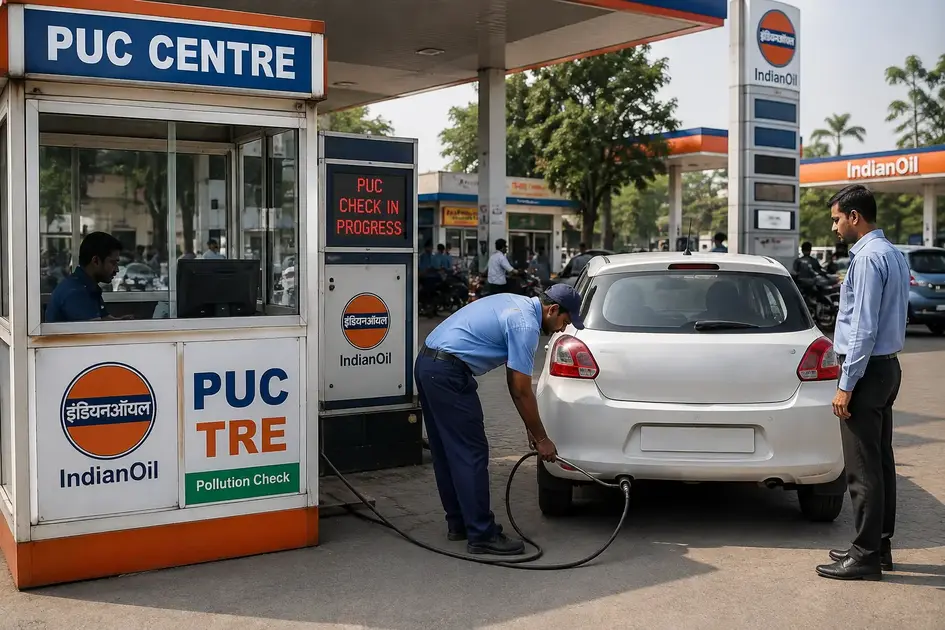
What Is a PUC Certificate? (PUC vs PUCC Meaning)
PUC stands for Pollution Under Control. The official document is actually called PUCC (Pollution Under Control Certificate) — this is the exact term used in government rules.
In everyday conversation, most people simply say “PUC certificate.” Both terms refer to the same document, so there’s no need to get confused between the two.
What is a PUC certificate of a vehicle, exactly? It’s a legal document confirming that your vehicle’s emission levels fall within the standards set by the government. It’s mandatory under the Motor Vehicles Act, 1988 and the Central Motor Vehicles Rules, 1989, for all petrol, diesel, CNG, and LPG vehicles. Electric vehicles (EVs) are exempt, since they produce no tailpipe emissions.
During the test, a gas analyser measures three things:
- Carbon Monoxide (CO) — how completely the engine burns fuel
- Hydrocarbons (HC) — unburnt fuel escaping through the exhaust
- Smoke opacity — particulate density, checked specifically for diesel vehicles
The entire test usually takes under 10 minutes at an authorised centre.
Why This Certificate Matters
Three practical reasons make it worth keeping current.
It’s a legal requirement. Every vehicle with an internal combustion engine must carry a valid one. Traffic police can check for it during any routine stop.
It protects your insurance claim. Many insurers ask for a valid certificate at the time of claim settlement, particularly for third-party claims. A lapsed one can complicate the process.
It reflects your vehicle’s health. High emission readings often point to an engine or fuel-system issue worth fixing before it gets worse.
How to Download PUC Certificate Online (Step by Step)
If your emission test is already complete and the data has been uploaded to the VAHAN database, downloading your certificate is straightforward:
- Visit the official Parivahan portal (puc.parivahan.gov.in)
- Select the “PUC Certificate” option from the menu
- Enter your vehicle registration number
- Enter the last 5 characters of your chassis number
- Type the captcha code shown on screen
- Click “PUC Details” or “Get Status”
- Your certificate will appear on screen — you can download or print it directly
This process is completely free. You are not charged anything extra just for downloading a duplicate copy.
Want to check your registration or ownership details at the same time? You can pull those up through our RC download and RC status guide using the same registration number.
Download PUC Certificate by Vehicle Number
If you don’t have your application number handy, that’s fine — your registration number and chassis number are enough. The chassis number is printed on your RC and stays the same for the life of the vehicle, even if ownership changes hands.
This method is particularly useful when your original certificate is lost or damaged. There’s no need to repeat the emission test — you can simply pull up a duplicate copy online.
Download PUC Certificate via DigiLocker or mParivahan App
DigiLocker is a government-run cloud storage service linked to your Aadhaar number. Once your emission test is complete, the PUC certificate typically gets uploaded to DigiLocker automatically.
To access it:
- Open the DigiLocker app or website and log in
- Go to the “Issued Documents” section
- Look for the PUC certificate linked to your state transport department
The mParivahan app works in a similar way — add your vehicle, and the PUC details show up directly, alongside your digital RC and DL.
One important point: a digital certificate shown via DigiLocker or mParivahan is just as legally valid as the physical copy, under the Information Technology Act, 2000. Showing it on your phone during a traffic check is enough.
PUC Certificate Not Showing Up? Here’s What to Do
This is where most guides go silent, but it’s a genuinely common problem:
- Certificate isn’t appearing on screen: Data from the testing centre can take 24–48 hours to reflect in the VAHAN database. Wait a bit and try again before assuming something is wrong.
- Still nothing after 48 hours: Contact the testing centre where you got tested directly. Data upload failures on their end are more common than you’d expect.
- Details are incorrect (wrong name/number): This needs to be corrected through your local RTO office — the online portal alone cannot fix data-entry errors. Our RTO vehicle information guide explains how to look up the right RTO for your registration.
- Got a certificate from an unauthorised agent: These certificates often won’t show up in the VAHAN database at all, since they weren’t issued by an authorised testing centre. Always get tested at an authorised centre to avoid this entirely.
PUC Certificate Fees and Charges
PUC testing fees are not fixed nationally — they vary by state and vehicle type. Based on publicly available pricing across states, here’s the general range:
| Vehicle Type | Typical Fee Range |
|---|---|
| Two-wheelers | ₹60 – ₹90 |
| Cars (petrol/CNG) | ₹80 – ₹130 |
| Diesel vehicles | ₹90 – ₹150 |
| Commercial vehicles | ₹100 – ₹250 |
Important: These are indicative ranges only, not official figures. Fees are set by each state transport department and testing centre and can change. Always confirm the exact amount with your local authorised PUC centre before your test. Downloading an already-issued certificate online, on the other hand, is always free — you only pay for the actual emission test, not the download.
PUC Certificate Validity — How Long Is It Valid?
Validity depends on the age of your vehicle and its emission norm compliance:
| Vehicle Type | Validity Period |
|---|---|
| New vehicle (first PUC) | 1 year from the date of registration |
| BS-IV/BS-VI vehicle (after renewal) | Commonly 6 months in most states, though some sources cite 1 year — confirm with your local RTO |
| BS-III and older vehicles | Renewal required every 3–6 months |
| Electric Vehicles (EV) | Not required |
Worth noting: In 2026, MoRTH proposed extending PUCC validity for BS6 vehicles (up to 6 years old) to 3 years instead of annual renewal. This is currently a draft proposal, not a confirmed rule — always check your certificate’s actual expiry date rather than assuming a new rule already applies.
Want to check your validity right now? Enter your registration and chassis number in Step 2 above — the expiry date is shown clearly on the downloaded certificate.
PUC Certificate Fine — How Much Is the Penalty?
Under Section 190(2) of the Motor Vehicles Act, 1988, the base penalty is:
- First offence: ₹1,000
- Repeat offence: ₹2,000
However, this figure isn’t uniform everywhere. In cities like Delhi, where pollution enforcement is stricter, the transport department has issued notices citing fines of up to ₹10,000, along with a possible 3-month driving licence suspension. Repeat violations can also carry imprisonment of up to six months in some cases.
If you’ve received a challan for this, you can check and clear it through our e-Challan online guide.
Practical tip: Confirm the actual enforcement rules for your state through your local RTO or state transport department, since these can vary significantly.
Bike vs Car PUC Certificate — What’s Different
The core process is the same for both — get tested at an authorised centre, then download online. But there are a couple of differences worth knowing:
- Bikes/Two-wheelers: Fees are generally lower than cars. New two-wheelers also get a 1-year initial validity, followed by regular renewals.
- Cars: The emission test is slightly more detailed (especially the smoke opacity test for diesel cars), and fees vary by vehicle class.
- Commercial vehicles: Penalties here tend to be stricter — some reports mention an additional ₹10,000 fine specifically for commercial vehicle owners/operators on top of standard penalties.
Frequently Asked Questions
What is a PUC certificate?
It’s a document confirming your vehicle’s emissions meet government standards. The full form is Pollution Under Control, and the official certificate name is PUCC.
What is a PUC certificate of a vehicle / for a vehicle?
Both phrases mean the same thing — a legal proof that a specific vehicle’s exhaust emissions have been tested and found within permissible limits. It’s issued after a physical emission test, tied to that vehicle’s registration and chassis number.
How do I download a PUC certificate online?
Visit the Parivahan portal, select “PUC Certificate,” enter your registration number and last 5 digits of your chassis number, complete the captcha, and click “Get Details” to download.
Can I renew my PUC certificate online?
No. Renewal requires a physical visit to an authorised testing centre for the emission test. Online access is only for downloading or checking an already-issued certificate.
How can I check my PUC certificate validity online?
Download your certificate using your registration and chassis number — the expiry date is printed clearly on it. No separate “check” step is needed once it’s issued.
Does a brand-new vehicle need a PUC certificate immediately?
No. New vehicles get an exemption for the first year from the date of registration, since the manufacturer’s certification is considered sufficient during this period.
Do electric vehicle (EV) owners need a PUC certificate?
No. EVs produce zero tailpipe emissions, so they’re fully exempt from PUC requirements.
Is there a fee for downloading a duplicate PUC certificate?
No, downloading a duplicate copy from the VAHAN portal is completely free. You only pay for the original emission test at the centre.
Conclusion
Downloading your PUC certificate online has become genuinely simple — all you need is your registration number and chassis number. That said, fees, validity periods, and fine amounts can vary by state, so it’s always worth double-checking with your local RTO. If your certificate isn’t downloading, wait 24–48 hours first, then reach out to your testing centre directly.
For everything else related to your vehicle — RC status, driving licence, or e-Challan payments — head back to the Sarathi Parivahan Sewa home guide for the full picture.